

Every phone system that answers on the internet is found quickly. SIP scanners look for open PBXs, guess extensions and passwords, and then try to place calls to expensive international numbers on someone else's bill. This report shows what reached SIP ports 5060 and 5061 on our honeypot sensors in 31 days, 7 October to 6 November 2026: who scanned, which extensions they tried and where they tried to call.

Key findings
- 8.707 addresses sent SIP OPTIONS requests to find phone systems in 31 days. In the first week of November, about 483 different addresses did so on an average day.
- 321 addresses probed extensions with 1.395.682 REGISTER requests on 73.681 different usernames, most of them extension numbers like 100, 1000 and 1001. 41 of them went on to try credentials, with 670.070 REGISTER requests carrying an Authorization header.
- 483 observed source addresses sent INVITE requests to place calls, with 8.474.125 INVITE requests carrying 5.312.916 distinct Call ID values, our measure of call attempts, to 256.749 different numbers. These are attempted call setups, not completed calls. 161 of these addresses were seen only over UDP, where the source cannot be validated, but they sent only 2% of the INVITE requests.
- The United Kingdom was the top destination. Of the 3.678.103 INVITE requests that used an international dialling prefix, 37% went to UK numbers, 22% to the US, Canada and the Caribbean and 14% to Mexico.
- friendly scanner is the exception, not the rule. Most SIP scanners sent no user agent at all: 7.309 of the 9.153 addresses that sent SIP requests (80%) never included one, and many used user agent strings that identify Polycom, Yealink, Grandstream and Cisco devices.
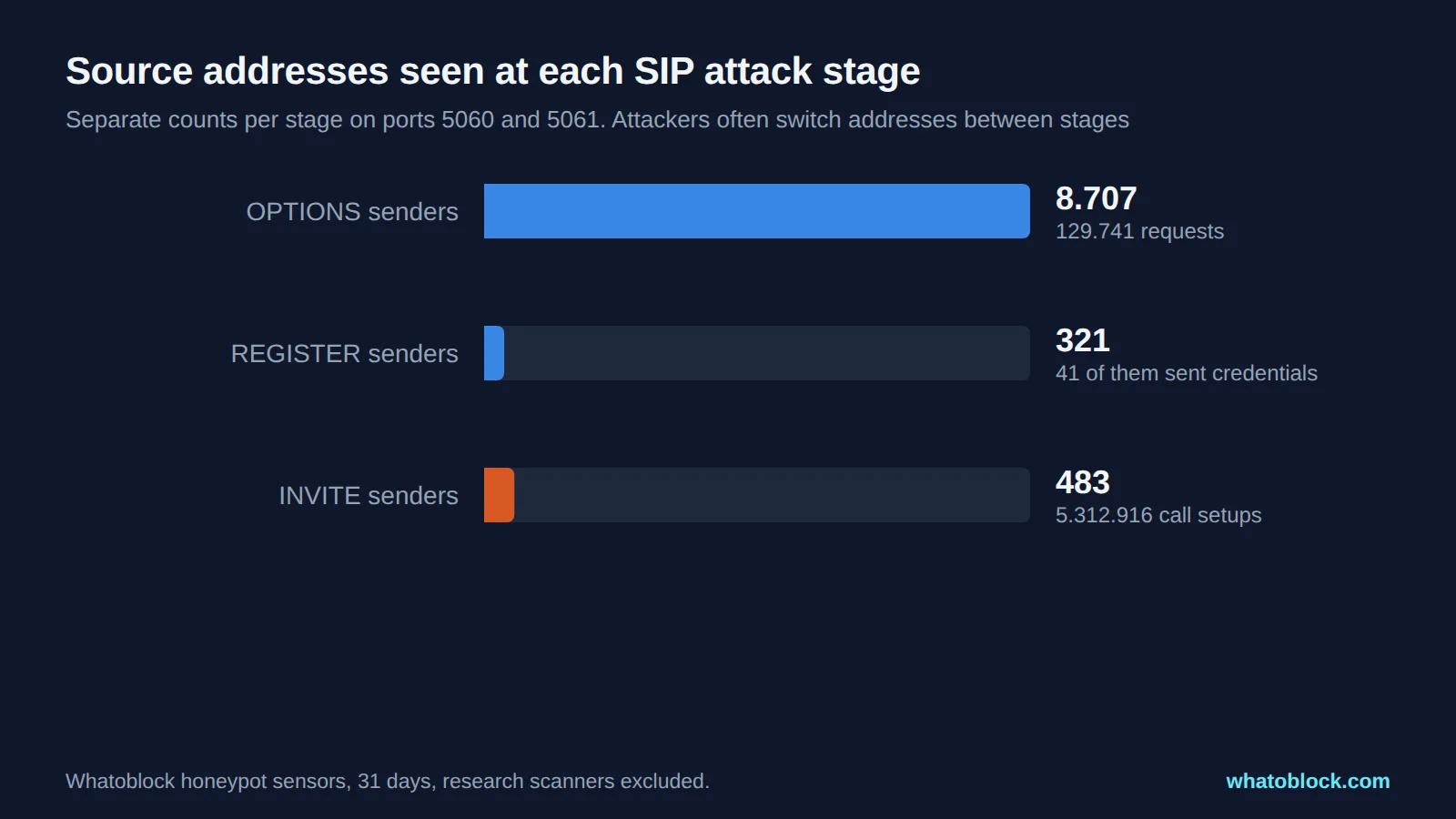
Addresses seen at each SIP attack stage. These are separate counts: attackers often use different addresses for each stage. Of the 321 REGISTER addresses, 41 also sent credentials.
What a SIP scanner does on port 5060
Short answer: port 5060 is the standard port for SIP, the protocol that sets up VoIP calls, over UDP or TCP. Port 5061 is the default port for SIP over TLS. A PBX that answers on 5060 from the internet will be scanned.
An attack has four steps, as a 2014 study of SIP honeypots by Aziz and colleagues described:
- Find SIP devices. An
OPTIONSrequest asks a SIP endpoint or proxy what it supports. An answer confirms that something speaking SIP is reachable, a PBX, a gateway or even a single IP phone, not necessarily a server. - Find the extensions. Usually
REGISTERrequests without credentials for extension 100, 101, 1000 and so on, as the 2014 study describes. A different error for existing and missing extensions tells the scanner which ones exist. Tools such as SIPVicious can also probe extensions withINVITEorOPTIONSrequests. - Guess the password. Repeated
REGISTERattempts with common passwords, often the extension number itself. - Make calls. With a working account, or on a PBX that allows calls without one, the attacker dials premium or international numbers and shares the revenue with whoever runs them. This is a form of toll fraud. When the calls go to high rate international numbers so that someone collects a share of the termination fees, it is called international revenue share fraud (IRSF).
Among the 108 attackers that study saw in both of its sensor deployments, more than 75% only scanned for servers. The study described the full four stage model, but it did not observe any attacker side INVITE packets during its own observation period. The researchers suggested that scan results could be shared between attackers, or that attackers switched addresses for the later stages. A 2019 FreePBX honeypot paper from the University of Southampton notes, citing earlier research, that the calls can come several months after an extension is first registered.
How many addresses scan SIP
In 31 days, 12.084 attacking addresses sent traffic to ports 5060 and 5061 on our sensors, not counting 4.217 known research scanner addresses. 8.707 of them sent a SIP OPTIONS request. 9.153 sent at least one SIP request of any kind. The rest sent traffic that did not contain a recognisable SIP message, typically from general port scans.
On an average day in early November, 483 different addresses sent SIP discovery requests. Separately, as a measure of exposure rather than of scanning, Shadowserver counted 5.881 SIP services answering its own OPTIONS probe on UDP port 5060 on 7 November 2026, a lower bound because it only tests UDP and IPv4.
friendly scanner and the other user agents they send
friendly-scanner is the default user agent of SIPVicious, an open source SIP audit tool first published in 2007. That is why it appears in Asterisk logs when SIPVicious runs with its default user agent. FreePBX has a similarly named warning, but that one comes from its own dial plan (see the FAQ below). In our data it is a small part of the traffic:
| User agent (selected strings) | Addresses |
|---|---|
| none in at least one request | 7.689 |
| SIP Scanner | 602 |
friendly-scanner | 161 |
| Cisco phone | 114 |
| zgrab/sip | 76 |
| Grandstream phone | 68 |
| MicroSIP | 63 |
| Asterisk PBX | 59 |
| Polycom phone | 50 |
| Linphone | 47 |
The table shows selected strings, not every user agent we saw: 1.844 addresses sent a user agent at least once. Counts cover all SIP requests, not just OPTIONS. An address is counted under every user agent it sent, and under "none" if at least one of its requests had no user agent, so the rows overlap. The user agent header is just text. Blocking friendly-scanner stops only the laziest scanners, although those 161 addresses sent 114.205 requests. The heaviest callers in our data claimed to be desk phones: 50 addresses using a Polycom user agent string sent 286.998 requests.
The extensions and passwords they try
321 addresses sent 1.395.682 REGISTER requests on 73.681 different usernames, 67.522 of them numeric extensions. Most of these requests probe which extensions exist. Authentication attempts carry credentials in an Authorization header: 41 addresses sent 670.070 of those. We count them as password guesses. The header alone does not show whether a login would have worked. The most tried usernames, counted over all REGISTER requests from the 321 addresses, with and without credentials:
| Username | REGISTER requests |
|---|---|
| admin | 27.742 |
| 100 | 12.483 |
| 1000 | 11.944 |
| 101 | 6.995 |
| 1002 | 6.089 |
| 1001 | 5.736 |
| 1003 | 4.655 |
| 102 | 4.635 |
Short numeric extensions are common in PBX deployments. A 2019 study of a FreePBX honeypot found that the only successful registrations used passwords matching the extension number. Extension 100 is also among the most probed usernames in our data.
Where they try to call
483 observed source addresses sent 8.474.125 INVITE requests to 256.749 different numbers. 161 of them were seen only over UDP and could be spoofed, but they sent just 132.292 of those requests. The requests carried 5.312.916 distinct Call ID values, which we use as a measure of distinct call attempts: retransmissions and authentication retries of the same call reuse its Call ID. That is the stage that can cause financial losses when calls connect on a real PBX. Our sensors never complete these calls. 3.678.103 of those INVITE requests (43% of all INVITE requests) used an international dialling prefix such as 00, 011, 9011 or +, which lets us see the destination country:
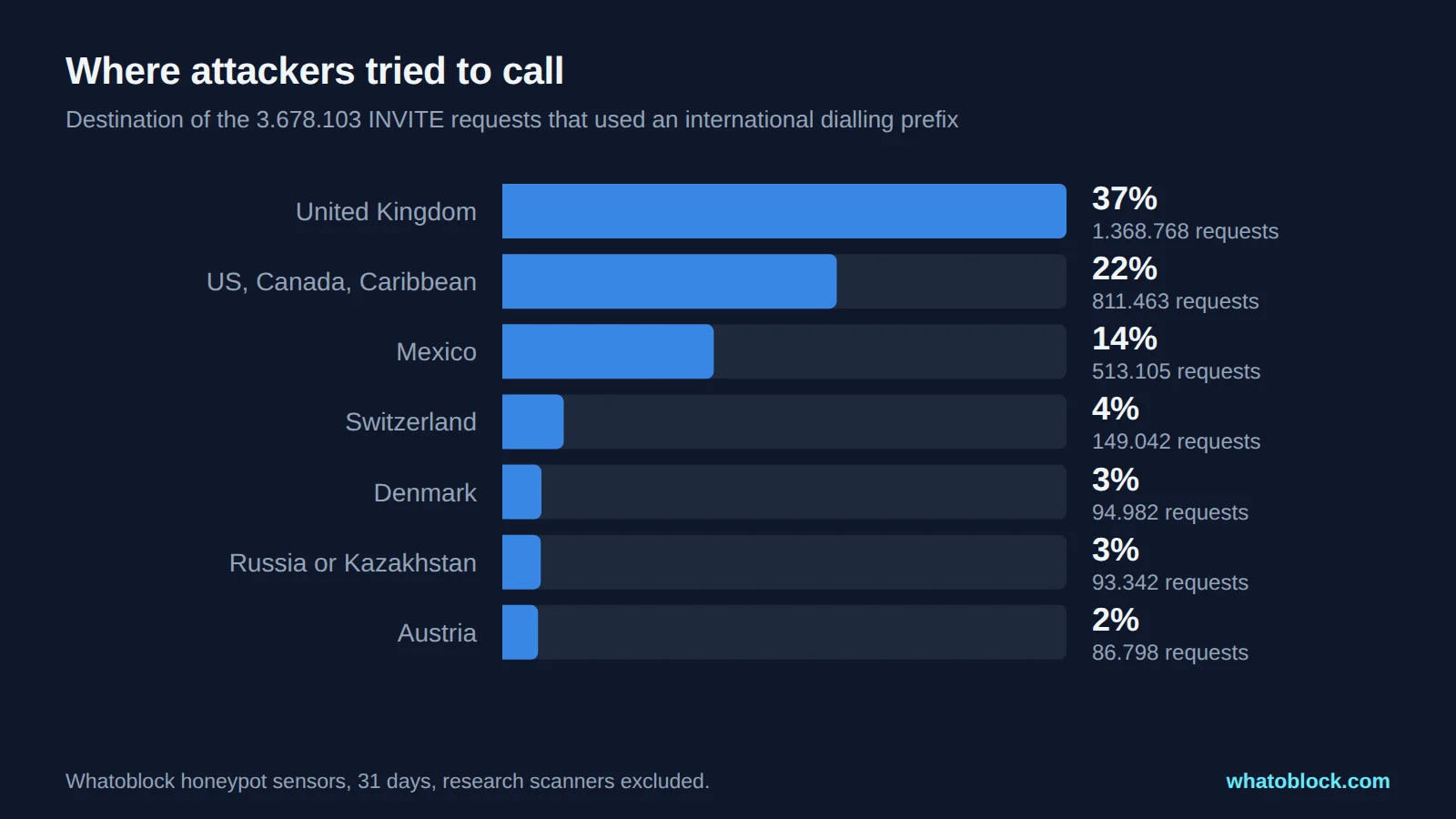
Top seven destinations of INVITE requests that used an international dialling prefix. They cover 85% of those requests.
Many calls test which dialling format the PBX accepts: the same number with 00, 011, 9011 or + in front. Numbers dialled in two or more of these formats received half of the INVITE requests we could read, including 123 of the 200 most called numbers. If a live PBX accepts one dialling format, the attacker learns which route works and whether the account can place calls. A 2021 study of a PBX honeypot by McInnes and Wills also found that most observed destinations were low cost: "the majority of these numbers were low cost and not premium in nature." Our reading of these patterns is route testing: once a format connects, a fraudster knows which numbers the PBX will dial, and the expensive calls would follow.
We do not publish the numbers themselves.
Why it matters: toll fraud
The Communications Fraud Control Association estimated global telecom fraud losses at about 39 billion USD in 2023, 2,5% of telecom revenue, with PBX fraud among the top methods. A single compromised PBX can run thousands of calls overnight. In one US case from 2013, the Justice Department described more than 13 million minutes of calls run through 4.800 hacked PBX systems.
Phone systems also have web interfaces with their own flaws. CISA lists several FreePBX vulnerabilities as exploited: CVE-2025-57819, added in August 2025, which allows unauthenticated access to the administrator interface, and CVE-2019-19006 and CVE-2025-64328, both added in February 2026. These target the FreePBX management interface rather than SIP signalling. Successful exploitation can compromise the PBX and give attackers another route to abuse its phone lines.
How to block SIP scanners
- Do not expose port 5060 to the whole internet. Allow SIP only from your SIP trunk provider and your remote users, or put phones on a VPN. The UK NCSC advises locking SIP down to trusted addresses.
- Reject unknown users the same way as wrong passwords. On legacy Asterisk installations that still use the
chan_sipdriver,alwaysauthreject = yesinsip.confstops scanners from telling existing and missing extensions apart. The setting does not apply to the PJSIP driver used by current Asterisk versions, wherechan_sipwas removed in Asterisk 21. It is still available in Asterisk 20 LTS. - Use long, random SIP passwords. Never the extension number.
- Restrict the dial plan. Block international and premium destinations you do not need, and set call limits per account.
- Ban repeat offenders automatically with fail2ban or your PBX's own intrusion protection.
- Block known scanners at the firewall. Our telecommunications blocklist covers SIP and other voice and carrier protocols. Setup guides for every major firewall are on the integrations page.
Frequently asked questions
What is friendly scanner in my Asterisk log?
The string is the default user agent of SIPVicious, a SIP scanning tool, so it usually points to someone probing your PBX. User agents are free text and can be faked, so look at the actual SIP requests to see what the sender is doing.
Why does FreePBX log Friendly Scanner from an IP address?
FreePBX writes this warning when an incoming call reaches its catch all dial plan context without matching a configured DID or caller ID. It is a FreePBX log message, not the friendly-scanner user agent, and it does not always mean a scanner: a misconfigured trunk or phone can trigger it too. Check the source address, the SIP request and your inbound routes before blocking it.
What does a SIP REGISTER brute force attack alert mean?
Someone is sending repeated REGISTER requests with an Authorization header, trying to log in as one or more extensions. REGISTER requests without credentials usually mean extension probing rather than password guessing. Block the source and make sure no extension uses a weak password.
Should port 5060 be open to the internet?
No. Allow it only from your SIP provider and known remote users, or use a VPN.
Why does my VoIP phone ring at night with caller 100 or no caller ID?
Scanners send INVITE requests to find working extensions. Phones that accept calls directly from the internet ring when they do. Put phones behind the PBX and block direct SIP from the internet.
What is VoIP toll fraud?
Making calls through someone else's phone system to expensive numbers, often numbers whose operator shares the revenue with the fraudster. The owner of the hacked system pays the bill.
Does blocking SIP scanner IPs stop toll fraud?
It removes most of the noise and many attackers, but not all. Combine it with an allow list, strong passwords and a restricted dial plan.
About this data
- Period: 7 October to 6 November 2026, UTC. Daily figures use 1 to 7 November 2026.
- Attackers: observed source addresses that sent traffic to ports 5060 and 5061 on our honeypot sensors over TCP or UDP, minus known research scanners. TCP requires a completed three way handshake, which gives much stronger validation of the observed source address, though not of who operates the machine. UDP sources can be spoofed and are not independently validated. Most counts rest on TCP: Of the 8.707 OPTIONS senders, 8.402 were seen only over TCP, 223 only over UDP and 82 over both. All 41 addresses that sent credentials, and all 670.070 of their REGISTER requests, came over TCP. The 102 REGISTER senders seen only over UDP sent 8.268 of the 1.395.682 REGISTER requests (under 1%). 161 of the 483 INVITE senders and 102 of the 321 REGISTER senders were seen only over UDP, and the UDP only INVITE senders account for 132.292 of the 8.474.125 INVITE requests (2%).
- SIP requests: classified by the SIP method in each message. REGISTER and INVITE counts are requests. Password guesses are REGISTER requests carrying an Authorization header, whether or not the login would have succeeded, and call attempts are estimated from distinct Call ID values, since retransmissions and authentication retries of a call reuse its Call ID. We did not separate repeat INVITEs inside an established call, which our sensors rarely see because they do not complete calls. User agents are shown as sent, with version numbers removed, and one address can appear under several.
- Destinations: country codes taken from the dialled number where it used an international prefix. Numbers are not published.
- Exposure count: Shadowserver, SIP services answering an OPTIONS probe on UDP port 5060 on 7 November 2026.
Sources
- SIPVicious, Enable Security and Sandro Gauci, 9 years of SIPVicious, Kamailio World 2016
- Aziz et al., A distributed infrastructure to analyse SIP attacks, IFIP Networking 2014
- Analysis of a PBX toll fraud honeypot, University of Southampton
- CAIDA, Analysis of a /0 stealth scan from a botnet, 2012
- CFCA, telecommunications fraud increased 12% in 2023
- US Justice Department, plea in an international PBX hacking conspiracy, June 2013
- McInnes and Wills, The VoIP PBX honeypot advance persistent threat analysis, ICISSP 2021
- NCSC, Private branch exchange best practice
- Asterisk, important security considerations and Configuring chan_sip, removal in Asterisk 21
- FreePBX security best practices
- CISA, Known exploited vulnerabilities catalog and NVD entries for CVE-2025-57819, CVE-2019-19006 and CVE-2025-64328
- Shadowserver dashboard
Check the live data
Open Scanner Recon with the last 24 hours selected.