

Industrial protocols such as Modbus, Siemens S7, DNP3 and IEC 104 were built for closed plant networks, not the internet. Most of them have no login at all. Tens of thousands of controllers still answer on the internet, and they get visited every day. This report shows who connected to industrial protocol ports on our honeypot sensors in 31 days, 7 October to 6 November 2026, and what they actually asked for.

In short, for security managers
- Industrial devices on the internet are visited every day. 29.957 addresses looked for them on our sensors. Most industrial protocols have no password, so anyone who can reach a device can talk to it.
- Almost all of it is reconnaissance. Visitors asked devices what they are and read their values. Only 4 addresses tried to change a setting.
- Reconnaissance still matters. The lists these scans build tell attackers where exposed controllers are, and a single command can have physical effects. In January 2024, malware that sent Modbus commands cut heating to more than 600 buildings in Lviv, Ukraine.
- Blocking scanners does not stop a targeted attacker. Only 2 of the 21 addresses in CISA's July 2026 advisory on attacks against US industrial controllers ever reached our sensors, and not on industrial ports.
- What to do: take controllers off the internet, allow remote access only through a VPN or an allow list, change default passwords, and block known scanners in front of anything that must stay reachable.
Key findings
- 29.957 attacking addresses connected to at least one of 19 industrial protocol ports, plus 10.682 addresses from known research scanners. Research scanners make up about a quarter of the sources on ICS ports, against about 1% of all attacking addresses on our sensors.
- They read, they do not write. 7.295 addresses asked Modbus devices to identify themselves and 4.487 read the system status of Siemens S7 controllers. Only 4 addresses sent a Modbus write, and none sent an S7 stop, a DNP3 operate or an IEC 104 control command.
- Schneider PLCs get special attention. 1.047 addresses used Modbus function code 90, Schneider Electric's proprietary programming protocol.
- DNP3 and IEC 104 are mapped, not attacked. 3.930 addresses walked DNP3 device addresses one by one, and 1.620 sent an IEC 104 general interrogation, a request for the station's current process data.
- Targeted attackers look different. Of the 21 addresses in CISA's July 2026 advisory on attacks against US PLCs, only 2 ever touched our sensors, once each, on non industrial ports.
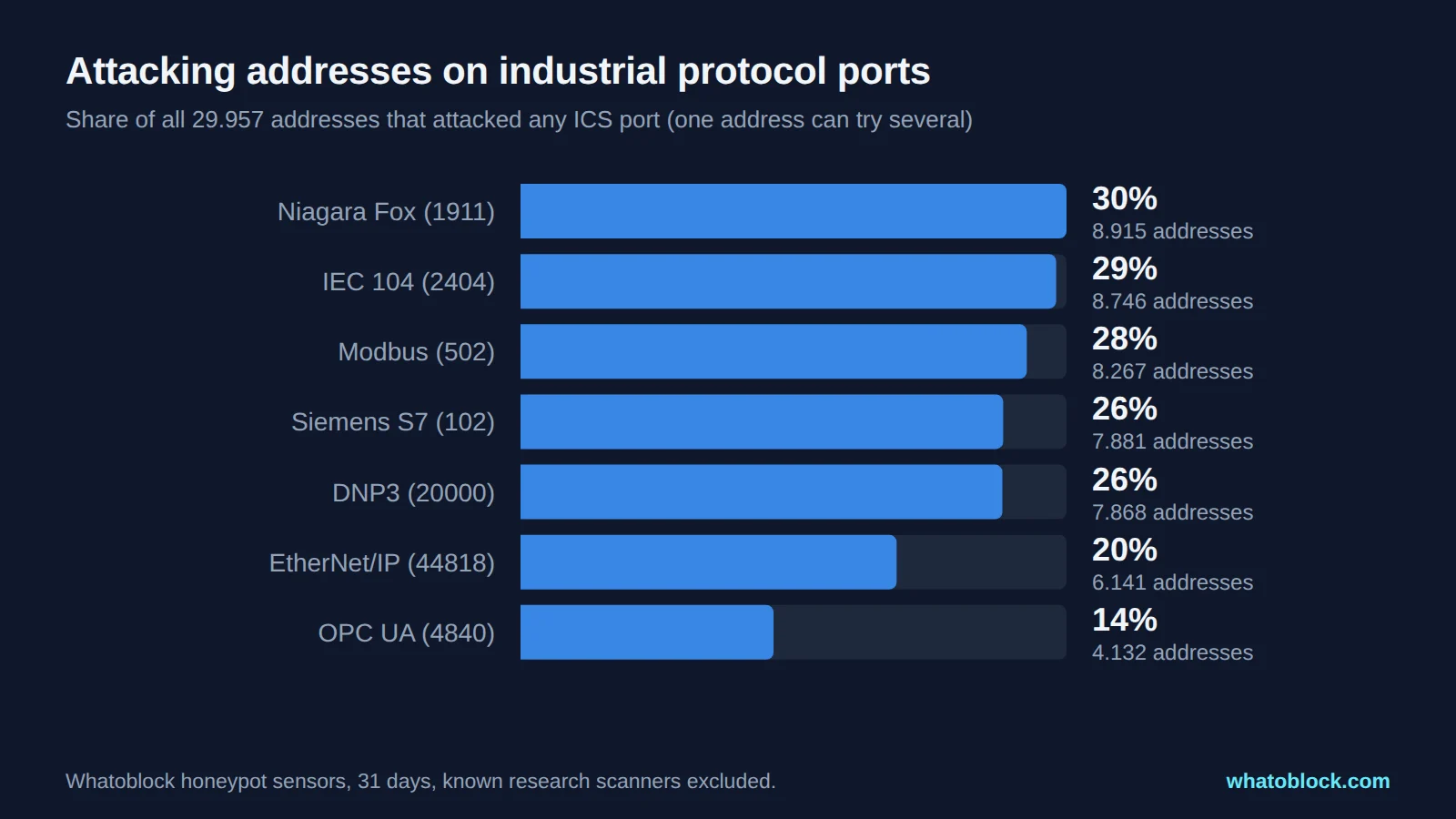
Attacking addresses per industrial protocol port.
| Protocol and port | Attackers in 31 days | Exposed on 6 November |
|---|---|---|
| Niagara Fox, 1911 | 8.915 | 16.295 |
| IEC 104, 2404 | 8.746 | 4.343 |
| Modbus, 502 | 8.267 | 11.080 |
| Siemens S7, 102 | 7.881 | 901 |
| DNP3, 20000 | 7.868 | 567 |
| EtherNet/IP, 44818 | 6.141 | 5.597 |
| OPC UA, 4840 | 4.132 | 3.466 |
How we measured
- Attackers: every address that connected to these ports on our honeypot sensors in 31 days, except addresses on our list of known research scanners. That list is narrow, so some of the "attackers" are unlabelled research projects. On ICS ports, read "attackers" as "sources we cannot identify as research".
- What they asked for: we decoded the protocol messages: Modbus function codes, S7 job types, DNP3 frames and IEC 104 frame types.
- Exposure counts: Shadowserver scans the internet every day for devices that answer each industrial protocol. Port 102 is shared by S7 and other protocols, and Shadowserver's S7 count dropped sharply in January 2026 after a change in how it classifies results.
- Ports, not plants. Our sensors are not real plants. They show who knocks and what they send, not what would happen inside a real control system.
Which industrial ports draw the most scanners
Every major industrial protocol drew between 4.000 and 9.000 attacking addresses in 31 days, and another 2.000 to 4.000 known research scanners. That is far more sources than there are exposed devices for some protocols: 7.868 addresses probed DNP3, while Shadowserver counted 567 DNP3 devices answering on the whole internet.
The same sources hit many protocols. Of 28.492 addresses that sent TCP traffic to these ports, 11.291 tried three or more of them and 4.531 tried ten or more. These are not plant specialists, but scanners that sweep every industrial port in turn, the same way they sweep databases and remote desktops.
Identify, read, control: three kinds of requests
A remote computer can ask an industrial device for three kinds of things, and they carry very different risks:
- Find and identify. The sender checks whether a device answers and asks what it is: vendor, model and firmware version. The Modbus device identification request and the S7 system status list do this. It is how target lists are built.
- Read values. The sender asks for live process data, such as the registers of a Modbus PLC or the current process data of an IEC 104 substation through a general interrogation. Nothing changes on the device, but the answers show how the process runs.
- Control. The sender writes a value, switches an output or stops the controller's program. This is the step that can move a valve or stop a pump, and it almost never appeared on our sensors.
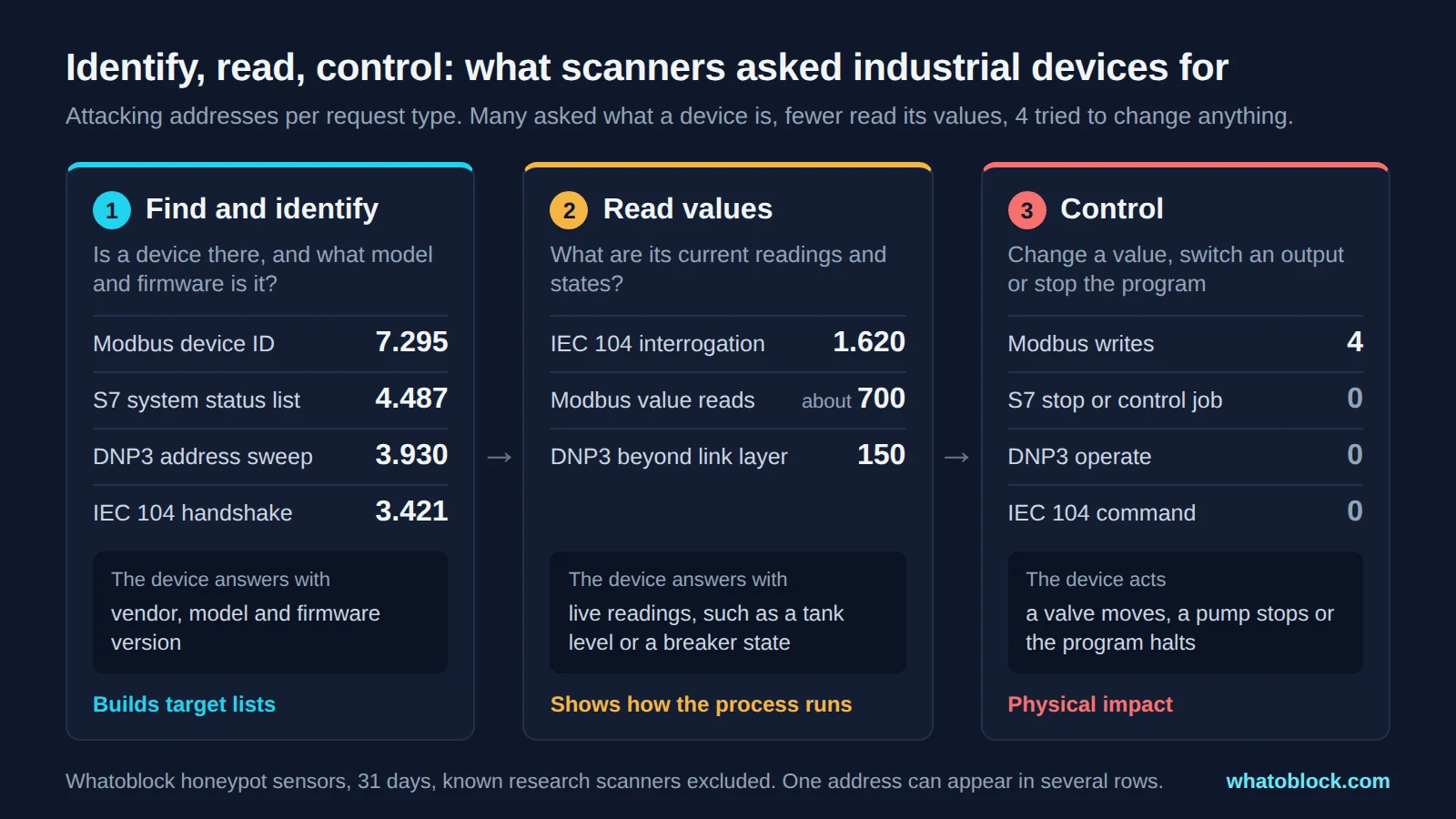
Attacking addresses per request type. DNP3 requests beyond the link layer are counted as reads because none of them was an operate command.
Schneider UMAS requests (1.047 addresses) are not in the diagram, because UMAS carries reading, programming and control in one protocol. Their function codes showed only identification and read requests, such as the PLC's identity and project information, and no writes, program downloads or stops. The protocol sections below explain each request.
Modbus TCP on port 502: who scans it and which function codes they send
Short answer: Modbus TCP uses TCP port 502 (802 for the secure version). Classic Modbus has no authentication: anyone who can reach a device can read and write its registers and coils.
Exposed: Shadowserver counted 11.080 Modbus devices answering on 6 November 2026.
Who scans it: 8.267 attacking addresses and 4.288 research scanners connected to port 502 in 31 days.
What they send:
- Read device identification (function 43): 7.295 addresses asked the device for its vendor, product and version. This is how scanners build a list of which PLC sits behind each address.
- Report server ID (function 17): 2.354 addresses.
- Schneider UMAS (function 90): 1.047 addresses used Schneider Electric's proprietary protocol, which engineering software uses to manage and program Modicon controllers. On our sensors these requests asked for the PLC's identity, project and memory, not for changes.
- Read registers and coils: about 700 addresses read actual process values.
- Writes: 4 addresses sent Modbus write commands.
Writes are rare in our data, but they are the dangerous part. In January 2024 the FrostyGoop malware sent Modbus commands to heating controllers in Lviv, Ukraine, and residents of more than 600 buildings lost heating for two days, according to Dragos. Dragos assessed with moderate confidence that FrostyGoop was used to target these controllers through Modbus port 502 open to the internet. The attackers had possibly entered the network earlier through a router facing the internet, and the network was not adequately segmented.
Siemens S7comm on port 102: connection probes and real S7 requests
Short answer: S7comm runs on TCP port 102 over ISO transport (TPKT and COTP). Older S7 controllers have no cryptographic authentication at the protocol level. Port 102 is also used by other protocols, so not every connection is S7.
Who scans it: 7.881 attacking addresses and 4.314 research scanners. 6.959 opened an ISO transport connection, and 4.660 went on to speak S7.
What they send: 4.487 addresses read system status lists (SZL), the S7 equivalent of asking for the model, firmware version and serial number. None sent a CPU stop or any other control job.
Exposed: Shadowserver counted 901 S7 devices on 6 November 2026, after a large drop in January 2026 that looks like a change in its method rather than devices disappearing.
DNP3 on port 20000
Short answer: DNP3 is the protocol of electric and water utilities in North America and Australia. It uses TCP and UDP port 20000 (19999 for secure DNP3).
Exposed: only 567 devices answered DNP3 on 6 November 2026.
Who scans it: 7.868 attacking addresses, far more than there are exposed devices. 4.708 sent real DNP3 frames.
What they send: almost all were link status requests to destination addresses 0, 1, 2, 3 and so on, the way a scanner walks a bus to find which device addresses respond. 3.930 addresses did this. Only 150 sent anything beyond the link layer, and none sent an operate command.
IEC 104 on port 2404
Short answer: IEC 60870-5-104 is the telecontrol protocol of European and Asian power grids. It uses TCP port 2404.
Exposed: 4.343 IEC 104 devices answered on 6 November 2026.
Who scans it: 8.746 attacking addresses. 3.498 sent real IEC 104 frames, almost all of them connection tests (TESTFR) and start commands (STARTDT).
What they send: 1.620 addresses sent a general interrogation, which asks the substation for its current process data. That is reading, not control. No address sent a control command such as a single or double command. The Industroyer2 attack on Ukraine's grid in 2022 used IEC 104 commands, but from inside the victim's network, not by scanning the internet.
Niagara Fox, EtherNet/IP and other protocols
- Niagara Fox (ports 1911 and 4911): the protocol of Tridium Niagara building management systems was the most scanned industrial port, with 8.915 attacking addresses on 1911 and 7.208 on 4911. 6.681 addresses sent a Fox hello to identify the system. Shadowserver counted 16.295 Niagara Fox systems on 6 November.
- EtherNet/IP (port 44818): Rockwell Automation and Allen Bradley controllers. 6.141 attacking addresses. CISA's July 2026 advisory names 44818 among the ports used against US PLCs.
- Others: GE SRTP (7.355 addresses), PC WORX (6.444), CODESYS (6.175), Mitsubishi MELSEC (3.971 to 4.463), Omron FINS (4.141), OPC UA (4.132) and HART IP (3.921).
- BACnet (UDP 47808): 398 addresses. UDP source addresses can be spoofed, so read this as packets claiming to come from those addresses.
Research scanners and unknown sources
Industrial ports attract researchers. In 31 days, 10.682 known research scanner addresses reached our ICS ports, against 29.957 others. A 2020 Cambridge study of 120 high interaction ICS honeypots found that most traffic came from well known scanners, and that "only nine made malicious use of an industrial protocol" over 13 months.
Our data agrees on the main point: almost everything that reaches an industrial port is reading, mapping and fingerprinting. Scanning is how attackers build target lists, though. The CISA advisories on hacktivists show what happens next: exposed control screens with default or no passwords get changed by hand, through remote access tools such as VNC.
Targeted attackers do not show up in scanning data
In July 2026, CISA, the FBI and partners updated their advisory on Iranian affiliated actors who disrupted PLCs in US critical infrastructure. It lists 21 addresses used against ports 44818, 2222, 102 and 502. We checked every one against our sensors since August. Only 2 appeared, once each, on non industrial ports.
That is an honest limit of honeypot data. Targeted operators pick their victims in advance and do not sweep the internet. A blocklist built from scanning removes the reconnaissance noise and the opportunistic attackers. It does not replace taking controllers off the internet.
How to keep scanners away from exposed controllers
- Take controllers off the internet. The joint CISA, FBI, EPA and DOE fact sheet from May 2025 puts it first: "Remove OT connections to the public internet." It notes that OT devices "are quickly found by searching for open ports on public IP ranges with search engine tools".
- Use a VPN or an allow list for remote access, never an open port.
- Change default passwords on HMIs, PLCs and engineering workstations.
- Use the secure versions where the devices support them: Modbus Security on port 802, secure DNP3 and S7 with protection levels.
- Block known scanners at the firewall in front of anything that must stay reachable. Our operational technology blocklist is built from addresses attacking industrial protocols, with setup for every major firewall on the integrations page.
Frequently asked questions
What port does Modbus TCP use?
TCP port 502. The secure version, Modbus Security, uses TCP port 802.
What port does Siemens S7 use?
TCP port 102, over ISO transport (TPKT and COTP).
What port does DNP3 use?
TCP and UDP port 20000. Secure DNP3 uses port 19999.
What is the IEC 104 port?
TCP port 2404.
Is BACnet port 47808 TCP or UDP?
UDP. BACnet/IP uses UDP port 47808.
Who scans ICS ports, and should I block them?
Research projects, search engines for internet devices and attackers building target lists. Industrial devices should not be reachable from the internet at all. Where they must be, block known scanners and allow only trusted addresses.
About this data
- Period: 7 October to 6 November 2026, UTC.
- Attackers: addresses that connected to industrial protocol ports on our honeypot sensors, minus known research scanners. Our research list does not cover every research project.
- Protocol requests: decoded from the messages each address sent. UDP sources can be spoofed.
- Exposure counts: Shadowserver dashboard, unique IPv4 addresses answering each protocol on 6 November 2026.
- Advisory check: the 21 addresses in CISA advisory AA26-097A, checked against our data from 1 August 2026.
Sources
- CISA, FBI and partners, AA26-097A, Iranian affiliated actors targeting PLCs and PDF
- CISA, FBI, EPA and DOE, Primary mitigations to reduce cyber threats to operational technology, May 2025
- CISA, AA23-335A, exploitation of Unitronics PLCs
- CISA and partners, AA25-343A, pro Russia hacktivists targeting OT
- NIST SP 800-82 Rev. 3, Guide to operational technology security
- NCSC, Secure connectivity for operational technology
- Dragos, FrostyGoop ICS malware
- ESET, Industroyer2
- Shadowserver, accessible ICS report
- Dodson, Beresford and Vingaard, Using global honeypot networks to detect targeted ICS attacks, CyCon 2020
- Censys, Who is knocking on your PLC?
- IANA, service names and port numbers
Check the live data
Open Scanner Recon with the last 24 hours selected.