

In 2016 the Mirai botnet took over hundreds of thousands of cameras, video recorders and routers with a short list of factory default passwords. Ten years later, that same list still makes up most of the Telnet login attempts on our sensors. In 31 days, 7 October to 6 November 2026, our honeypot sensors logged 8.498.080 Telnet login attempts from 98.023 addresses. This is what they tried, and what they did once they got in.

Key findings
- Mirai's list is alive. Every one of the 61 unique username and password pairs in Mirai's 2016 source code was tried on our sensors. Together they made up 5.913.144 of 8.498.080 login attempts (70%), and 58.877 of 98.023 attacking addresses (60%) tried at least one.
- admin / admin is still number one, tried by 18.486 addresses.
- New defaults joined the old ones.
root / GEPON, the hardcoded password of a FiberHome fibre router, was tried by 8.773 addresses and drew 891.985 attempts, more than any Mirai pair except admin / admin. - Logging in is only step one. 46.279 addresses ran
/bin/busyboxchecks, 37.619 wrote files byte by byte withecho, and 15.745 tried to download malware. - Some "passwords" are commands. Sequences like
start, enable, config terminal, system, shell, share not credentials. They are typed after logging in to escape a router's limited command line.
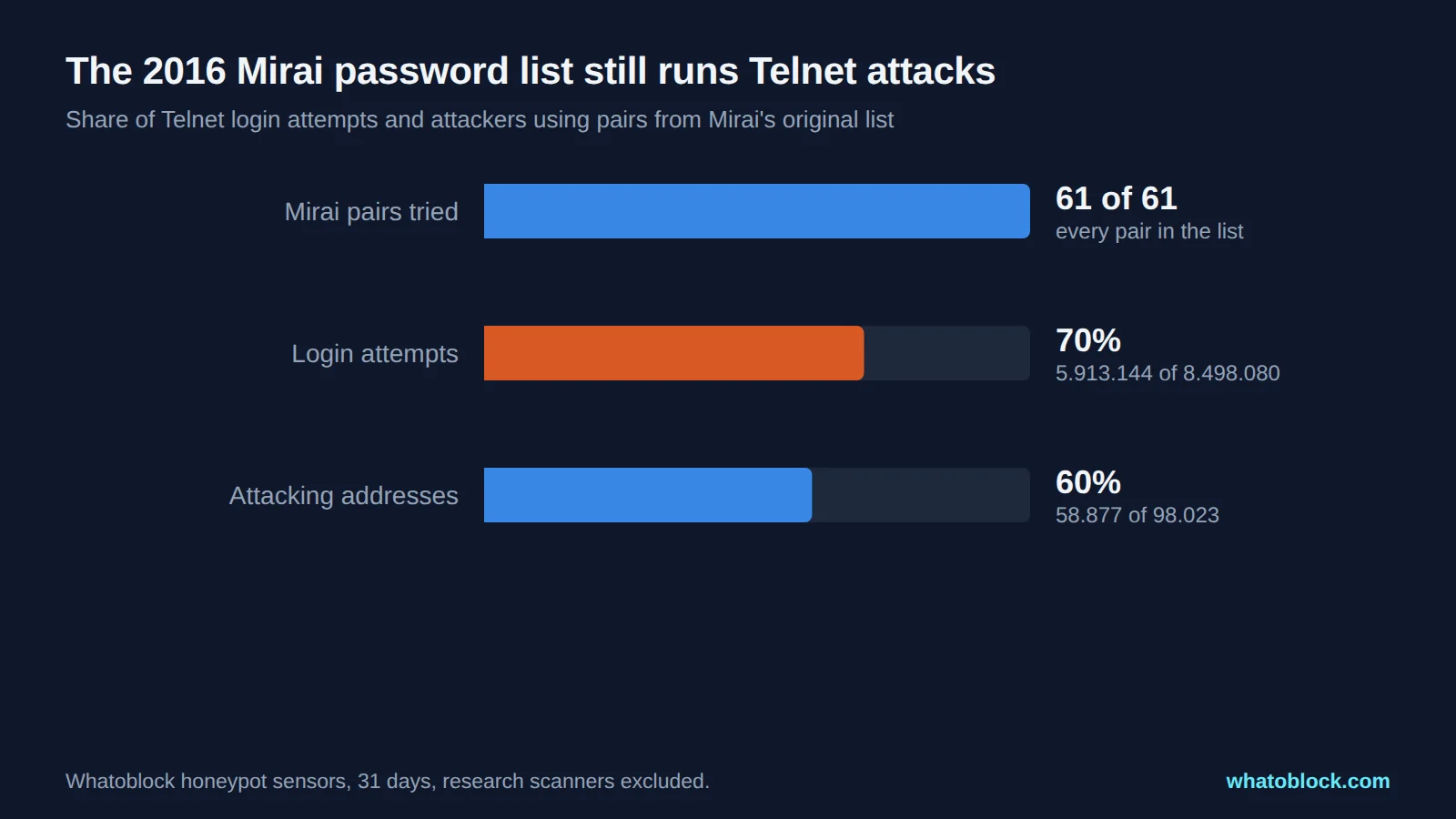
Share of Telnet login attempts and attackers using pairs from Mirai's original list.
The most tried Telnet usernames and passwords
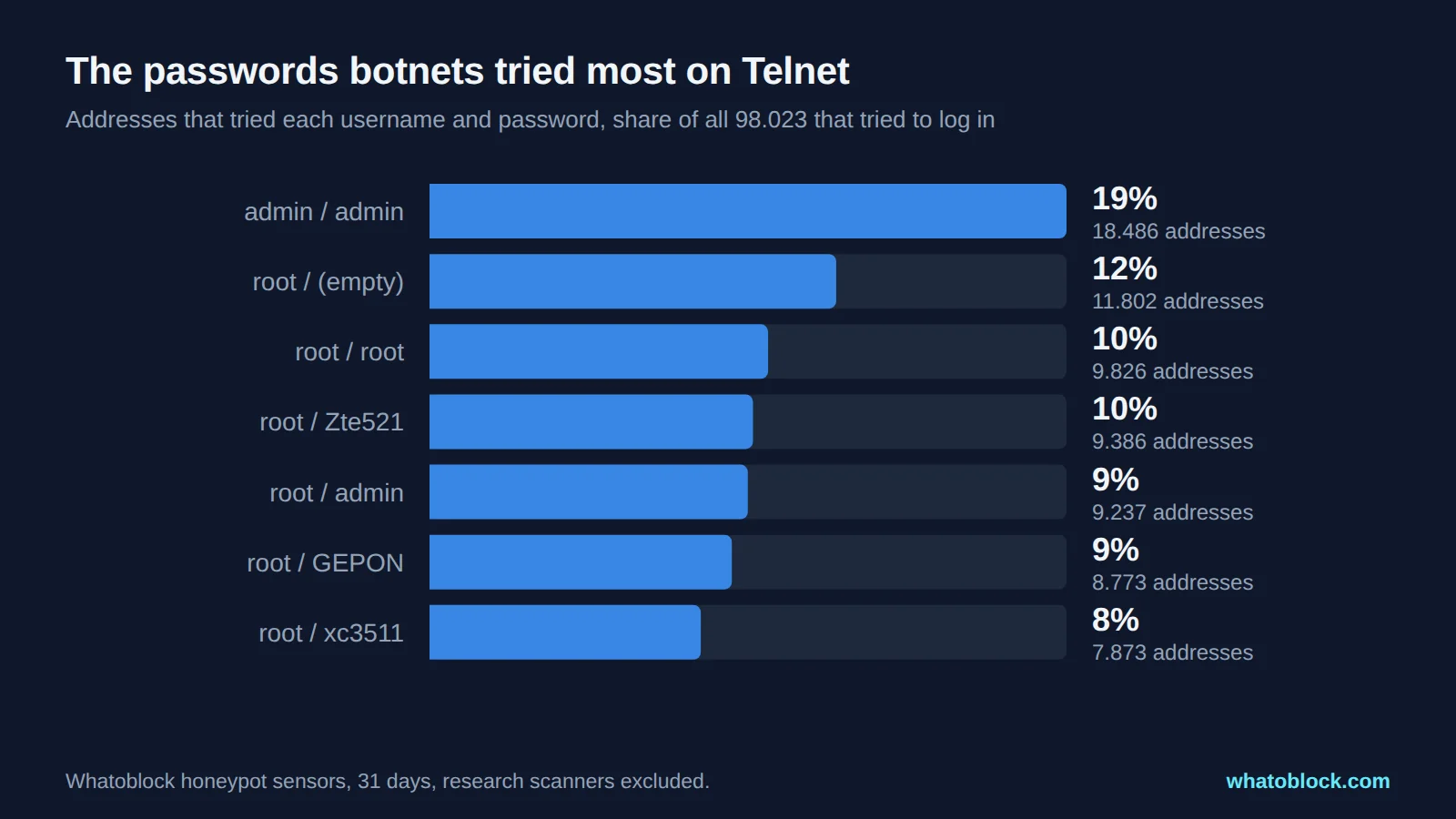
Addresses that tried each username and password.
| Username and password | Addresses | In Mirai 2016 |
|---|---|---|
| admin / admin | 18.486 | yes |
| root / (empty) | 11.802 | yes |
| root / root | 9.826 | yes |
| root / Zte521 | 9.386 | yes |
| root / admin | 9.237 | yes |
| admin / 1234 | 8.786 | yes |
| root / GEPON | 8.773 | no |
| guest / 123456 | 8.633 | no |
| root / xc3511 | 7.873 | yes |
| root / juantech | 7.808 | yes |
| root / hi3518 | 7.571 | yes |
| support / support | 7.353 | yes |
| root / vizxv | 7.306 | yes |
| guest / guest | 7.283 | yes |
| user / user | 7.197 | yes |
| root / 123456 | 7.180 | yes |
| root / hg2x0 | 7.117 | no |
| root / xmhdipc | 6.906 | yes |
| root / default | 6.841 | yes |
| root / 7ujMko0admin | 5.612 | yes |
Device names below come from the 2016 analyses by Krebs on Security and the USENIX Security study of Mirai, and from the 2021 disclosure of FiberHome router flaws (CVE-2021-27172) for GEPON. In logs these pairs often appear as root xc3511 or root:xc3511.
What these passwords are and why they still work
These are not random guesses. Most are passwords that came from the factory, and on many cheap devices they cannot be changed, because they are built into the firmware.
- root / xc3511 had the highest weight in Mirai's list, which made it the pair Mirai tried most often. Flashpoint found in 2016 that it was hardcoded in DVR and camera boards from XiongMai, with Telnet always on (CVE-2016-1000245).
- root / vizxv and root / 7ujMko0admin belong to Dahua cameras, according to the 2016 analyses.
- root / Zte521 is a ZTE router default, still in current botnet wordlists.
- root / GEPON is a hardcoded root password found in the FiberHome HG6245D fibre router, published in 2021. On that router it opens a Linux shell on port 26 that is off by default, so we cannot tell which devices the bots trying it on ports 23 and 2323 expect to find. It is not in Mirai's list, but it is now one of the most tried pairs.
- root / admin belongs to IPX DDK network cameras, root / juantech to Guangzhou Juan Optical DVRs, root / hi3518 to cameras built on HiSilicon chips and root / xmhdipc to Shenzhen Anran cameras, according to the same 2016 analyses.
Mirai picked pairs from a weighted list and tried up to 10 per device. It sent 1 in 10 probes to port 2323 and the rest to port 23. The USENIX study counted a peak of about 600.000 infected devices in late 2016. The source code was published in September 2016, and its release led to many Mirai variants, many of them building on the original code.
New defaults that were not in the Mirai list
Of 7.104 different pairs our sensors saw, these stand out because they were not in the 2016 list but are tried by thousands of addresses:
root / GEPON(8.773 addresses),gpon / gpon(5.333) androot / Pon521(6.370): fibre router credentials.guest / 123456(8.633) andadmin / admin1234(5.581).root / hg2x0(7.117),root / bluehorse(6.570),telnetadmin / telnetadmin(6.028),root / Fireitup(5.816).admin / BrAhMoS@15(5.756) andadmin / GeNeXiS@19(5.697), passwords that look like ISP or vendor defaults.e8ehome / e8ehomeande8telnet / e8telnet(around 4.500 each).
Each new device model with a shared default password adds a line to these lists, and the lists never shrink.
What bots do after they log in
106.437 attacking addresses sent traffic to Telnet ports 23 and 2323, and 98.023 of them sent a login. Nearly all addresses that sent the commands below also sent a login:
- Escape the router menu (24.387 addresses). Many routers open a limited command line after login. Bots type
enable,system,shellandshto reach a real shell. This is exactly the sequence in Mirai's code. A longer version,start, enable, config terminal, system, linuxshell, su, shell, sh, came from 17.095 addresses. - Check for busybox (46.279 addresses).
/bin/busyboxfollowed by a word, such as/bin/busybox MIRAI. If the device answers "applet not found", the bot knows it has a real Linux shell with busybox. - Write the malware byte by byte (37.619 addresses). Small devices often have no
wgetorcurl, so bots write the binary withecho -eand hexadecimal escapes into a temporary file, one chunk at a time. - Download (15.745 addresses). Where tools exist,
wget,tftp,curlorftpgetfetch the malware from a download server. - Make it run (16.085 addresses).
chmod 777and execute.
A typical session looks like this:
enable
system
shell
sh
/bin/busybox hostname PBOC
/bin/busybox echo > /tmp/.b && sh /tmp/.b && cd /tmp/
The download servers these bots use are what we track as C2 and malware servers. See what a C2 server is and our live C2 server list.
Where Telnet stands in 2026
Telnet sends passwords in plain text and has been obsolete for decades, but it is still the front door of many embedded devices. Shadowserver counted about 800.000 addresses answering Telnet in January 2026. On our sensors, Telnet was one of the most attacked services in our October 2026 report.
The law is catching up. Since 29 April 2024, the UK's product security rules require passwords to be "unique per product" or "defined by the user", with fines of up to 10 million pounds or 4% of worldwide revenue, whichever is higher. ETSI EN 303 645, the European standard for consumer IoT, sets a similar rule. California has required a unique password per device, or a new one set by the user before first use, since 2020, and CISA has asked manufacturers to eliminate default passwords. Devices sold before these rules are still online, and the factory passwords they shipped with are still on the lists bots try against our sensors.
How to protect devices and networks
- Turn Telnet off. If a device has it, disable it. If it cannot be disabled, do not connect the device to the internet.
- Change every default password, and replace devices whose password is hardcoded.
- Block ports 23 and 2323 inbound at the edge of your network.
- Check your own network for infected devices. Outbound connections to download servers and unusual Telnet traffic from cameras or recorders are warning signs.
- Block known attackers. Most of these addresses are infected devices themselves, and they change. Our IoT blocklist and the attacker categories in every plan are rebuilt every hour. Setup guides for every major firewall are on the integrations page.
Frequently asked questions
What is xc3511?
A factory default root password used in Chinese DVRs and IP cameras built on XiongMai boards. It was the most weighted password in Mirai's 2016 list. If you see root xc3511 in your logs, an automated scanner, usually part of a botnet, tried to log in to your device over Telnet.
What is the Mirai password list?
The list of username and password pairs in the source code of the Mirai botnet, published in 2016. It has 62 entries, and guest / 12345 appears twice, so 61 pairs are unique. It contains factory defaults of cameras, recorders and routers. Every pair on it was still tried on our sensors in October and November 2026.
What do vizxv, 7ujMko0admin, xmhdipc and Zte521 mean in my logs?
They are default passwords of specific devices: vizxv and 7ujMko0admin of Dahua cameras, xmhdipc of Shenzhen Anran cameras and Zte521 of ZTE routers. Seeing them means an automated scanner, usually part of a botnet, tried to log in to your device.
Why do attackers send start and enable?
These are commands, not passwords. Many routers open a limited menu after login, and bots type enable, system, shell and sh to break out of it into a real shell.
Why do botnets still try passwords from 2016?
Because they are still in botnet wordlists, and devices with these factory passwords are likely still online. Some cannot change them because the password is built into the firmware.
Which ports do Telnet botnets scan?
Mainly TCP port 23, and port 2323, which Mirai also scanned.
Is Telnet still safe to use?
No. It sends passwords in plain text and is the main target of IoT botnets. Use SSH, and turn Telnet off wherever you can.
About this data
- Period: 7 October to 6 November 2026, UTC. All figures come from queries run on 8 November 2026. A later recount of the same period can differ slightly as stored data changes.
- Login attempts: messages to ports 23 and 2323 on our honeypot sensors that contain one username and one password, sent by 98.023 addresses. Command sequences sent after login are counted separately. Research scanners are excluded.
- Mirai list: the 61 unique username and password pairs decoded from the scanner code of the 2016 Mirai source release.
- After login: we searched the traffic of all 106.437 attacking addresses that sent anything to ports 23 and 2323 for the commands above, not only the 98.023 that sent a login. Each command count is the number of addresses that sent it at least once. Many addresses sent no commands at all, and nearly all that did also sent a login.
Sources
- Mirai source code, scanner.c
- Antonakakis et al., Understanding the Mirai botnet, USENIX Security 2017
- Krebs on Security, Who makes the IoT things under attack?, October 2016
- CISA, Heightened DDoS threat posed by Mirai and other botnets, October 2016
- Flashpoint, When vulnerabilities travel downstream, October 2016 (archived)
- Pierre Kim, FiberHome ONT vulnerabilities, January 2021
- Fortinet, tracking a Mirai variant in 2026
- Pa et al., IoTPOT, USENIX WOOT 2015
- Shadowserver, accessible Telnet report
- UK Product Security and Telecommunications Infrastructure regulations 2023
- ETSI EN 303 645, Cyber security for consumer IoT
- CISA, Secure by Design alert on eliminating default passwords, December 2023
Check the live data
Open Botnet C2 Servers with the last 24 hours selected.