

On 23 October at 03:22 UTC, Whatoblock Heartbeat recorded an address registered to the Executive Office of the President of the United States working as a residential proxy exit.

We went looking for more. Heartbeat is our own proxy detection. Every record is an address we connected through ourselves and confirmed as a working proxy exit, and our honeypot sensors show which of those addresses attack. Between 17 October and 16 November 2026, Heartbeat recorded 4.545.806 residential proxy addresses and 33.055 datacenter proxy addresses. Among them we found Russia's Federal Guard Service, the International Monetary Fund, a nuclear weapons research laboratory, CERN, a cruise line and an island in the Indian Ocean that hosts a military base.
The short version
- 46 networks labelled as government or public bodies appeared in the residential proxy data, with 309 addresses that IP databases place in 27 countries. 31 of those networks show exactly one address.
- The datacenter proxy data had one address each from the IMF, Lawrence Livermore National Laboratory, CERN and the US weather agency NOAA.
- Starlink is the eighth largest residential proxy network we track, with 47.946 addresses in 179 countries. In South Sudan it accounts for 60 of the 70 residential proxy addresses we saw.
- Heartbeat keeps one record per address per month, and each record is a proxy exit we tested ourselves.
How a government address becomes a proxy exit
A residential proxy is a home or office connection that someone else rents to route their traffic. The addresses usually come from apps that share bandwidth, free VPNs, infected routers and TV boxes, and malware. We explain the mechanics in what is a residential proxy.
None of that needs a server in a ministry. One common route is a software development kit, or SDK. Proxy companies pay app developers to build their SDK into free apps, often per download. Once someone installs the app, the SDK runs in the background and routes the proxy company's customer traffic through that phone or computer, as the FBI describes. When Google disrupted the IPIDEA proxy network in January 2026, it found more than 600 apps with code connecting to IPIDEA's servers, and many of the apps it analysed did not tell users that their device had joined the network (Google Threat Intelligence).
Picture a free game on a visitor's phone in a ministry waiting room. While the phone is on the guest wireless network, the SDK inside the game routes strangers' traffic out through that network, and everything on it leaves through the ministry's public address. When our collectors connect through that proxy, the traffic leaves from the ministry.
That is the most likely story for most of what follows, and the more addresses a network has in the data, the more devices on it were doing this.
One address from the US president's office
The address registered to the Executive Office of the President was recorded on 23 October. Heartbeat connected through it that day and confirmed it was working as a proxy exit, so a device using the address was letting other people route traffic through it. IP databases place the address in Philadelphia rather than Washington, and it never contacted our honeypots.
Layer3 published this first. It reported that residential proxy traffic left the same network, AS2650, 236 times between 5 October and 3 November. The exits came through 28 different proxy services and from 6 addresses, on 26 of those 30 days. Layer3 reads the timing as one person's device carrying a proxy SDK, and notes that its data shows the exits, not the device behind them (Layer3). Our record from 23 October falls inside that period and comes from our own testing, so it is a separate observation of the same problem. Heartbeat keeps one record per address per month, which is why we have one record where Layer3 counted 236 exits.
These networks also appeared with a single address each:
| Organisation | Country |
|---|---|
| Executive Office of the President | United States |
| Federal Guard Service | Russia |
| Federal Police | Brazil |
| Philippine National Police | Philippines |
| Ministry of the Interior and Public Security | Chile |
| Irish Government | Ireland |
| New York State Unified Court System | United States |
| Information Technology and Cyber Security Service | Moldova |
| Ministries of Finance | Thailand and Nepal |
| United Nations Office at Nairobi | Kenya |
| United Nations Logistics Base | Spain |
Russia's Federal Guard Service, also known as the Federal Protective Service, protects senior officials, including the president, and provides secure communications, according to the Jamestown Foundation. Its address appeared on 7 November.
A few government networks have more behind them. The finance secretariat of the Mexican state of Jalisco had two neighbouring addresses, recorded by two different Heartbeat collectors on 4 and 5 November. Montgomery County in Maryland had three addresses from two collectors, and one of them probed our honeypots for ScreenConnect and Neo4j. The City and County of San Francisco had four.
Three public sector networks were much larger. Afghanistan's Government Communications Network had 111 residential proxy addresses from four collectors across the whole month, and 9 of them sent traffic to our honeypots. It had not stopped when the month ended: on 17 November Heartbeat recorded three more addresses in the same network working as proxy exits. The network registered to Thailand's Ministry of Education had 97, and the one registered to Hungary's government IT agency, KIFÜ, had 10.
All 309 government addresses together are a tiny slice of the residential data: about 7 in every 100.000 addresses.
The IMF, a nuclear weapons research lab and CERN
Datacenter proxies are supposed to live in clouds and hosting companies. These did not:
- International Monetary Fund, 16 November
- Lawrence Livermore National Laboratory, 16 November
- CERN, 3 November
- National Oceanic and Atmospheric Administration, 16 November
- A State of Tennessee address on AT&T, 16 November
- The Consulate General of Brazil on a US business fibre network, 16 November
Each is one address, and none of them contacted our honeypots. After our period ended, Lawrence Livermore had more: on 17 November Heartbeat recorded the two addresses next to its first one working as datacenter proxy exits too. Datacenter proxy data is thinner than the residential data: only 5 of the 33.055 addresses were recorded by more than one collector. Each label means only that the address is registered to that organisation.
The datacenter data also had one address each registered to Northrop Grumman, Intercontinental Exchange (the owner of the New York Stock Exchange), Ford, Sony Pictures, Riot Games, American Airlines and the Church of Scientology.
Starlink is one of the biggest residential proxy networks
Starlink, SpaceX's satellite internet service, had 47.946 residential proxy addresses in 179 countries. Only seven networks had more, all of them large telecom operators such as Uruguay's ANTEL and Maroc Telecom. Starlink is ahead of Saudi Telecom and Rostelecom.
In some places with few other ways to get online, Starlink accounts for most of the residential proxy addresses we observed.
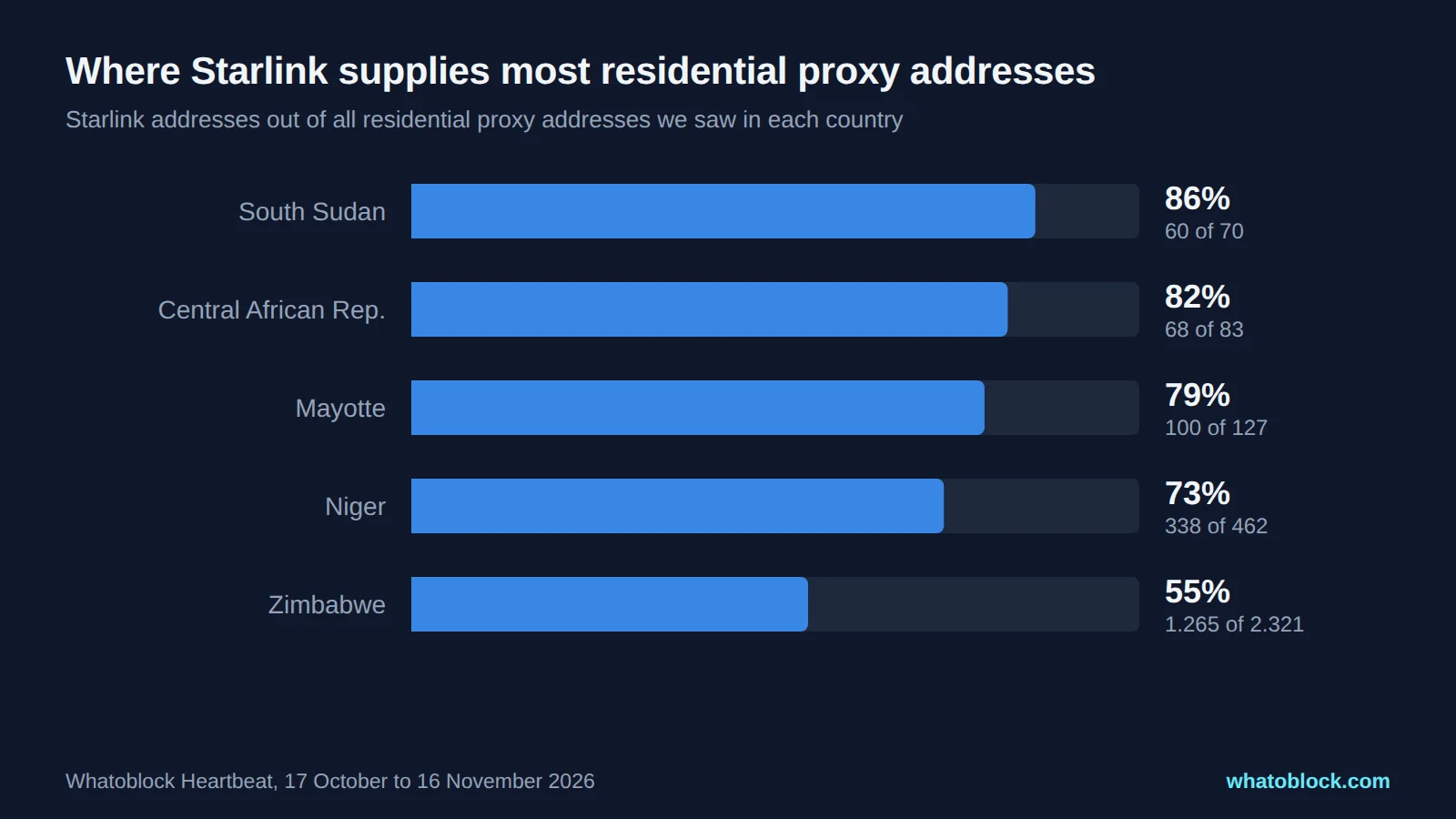
In South Sudan, 60 of the 70 residential proxy addresses we saw were Starlink connections.
We also saw Starlink proxy addresses located in Syria (788), Yemen (194), Libya (108) and Sudan (42). Satellite geolocation is approximate, so treat country labels as the IP database's best guess.
2.745 of Starlink's 47.946 residential proxy addresses sent at least some traffic to our honeypots, almost 6%, against just over 3% of all residential proxy addresses. That figure counts addresses, not how much they sent. Two addresses produced more than half of all the events from Starlink addresses, mostly Ethereum peer discovery, which is blockchain software looking for other nodes. By default Starlink puts customers behind shared public addresses (carrier grade NAT, as its help centre explains), so a higher share of addresses touching a honeypot does not mean Starlink users are twice as likely to attack anyone.
Cruise ships, remote islands and a railway
The datacenter data had 18 addresses registered to Carnival Corporation, the cruise line, over three days, labelled in the US, the UK and Singapore. Satellite operators that connect ships and aircraft were there too, Inmarsat with 12 addresses and Intelsat with 7, and so was Icomera, which runs onboard internet on trains and buses.
The telecom arm of the Slovak railways had 4 datacenter proxy addresses. Three of them sent traffic to our honeypots, probing Jupyter, Vault, Consul and Ethereum RPC.
The residential data reached some of the most remote places on earth. Two addresses on Diego Garcia, the island in the Chagos archipelago that hosts a joint UK and US military base, were recorded by two different collectors on 26 October and 11 November. A Starlink address appeared in South Georgia, a subantarctic island with no permanent civilian population. Saint Helena had 7 addresses, the Falklands 28 and Tuvalu 32. No addresses in our proxy data were geolocated to North Korea, the Vatican or Antarctica during this period.
Labels go stale
Every organisation name in this article comes from IP databases, and those can be wrong.
Old company blocks change hands. A block labelled Procter and Gamble is mostly used by a hosting company now. Electric utilities in the data, such as Knoxville Utilities Board with 50 datacenter proxy addresses, also sell home fibre, so those addresses are most likely customer lines.
The categories blur too. One unfamiliar network supplies 13.970 of the 33.055 datacenter proxy addresses, 42%. They are every address from .1 to .254 in 55 /24 blocks, all placed in Dallas, although other IP database records label some of the same addresses as Ukrainian and British home broadband. More datacenter proxy addresses sit on US home broadband networks (4.803) than on the 12 biggest clouds combined (4.163), and 9.557, 29%, were also recorded as residential proxies.
The residential data, in turn, included 12.738 addresses on cloud and hosting networks, among them 707 from an app hosting platform and 169 from Amazon. Only 168 of them were also recorded as datacenter proxies. They were busier too: 1.881 of them (15%) sent traffic to our honeypots, against 149.063 of all 4.545.806 residential proxy addresses (3%), four and a half times the rate.
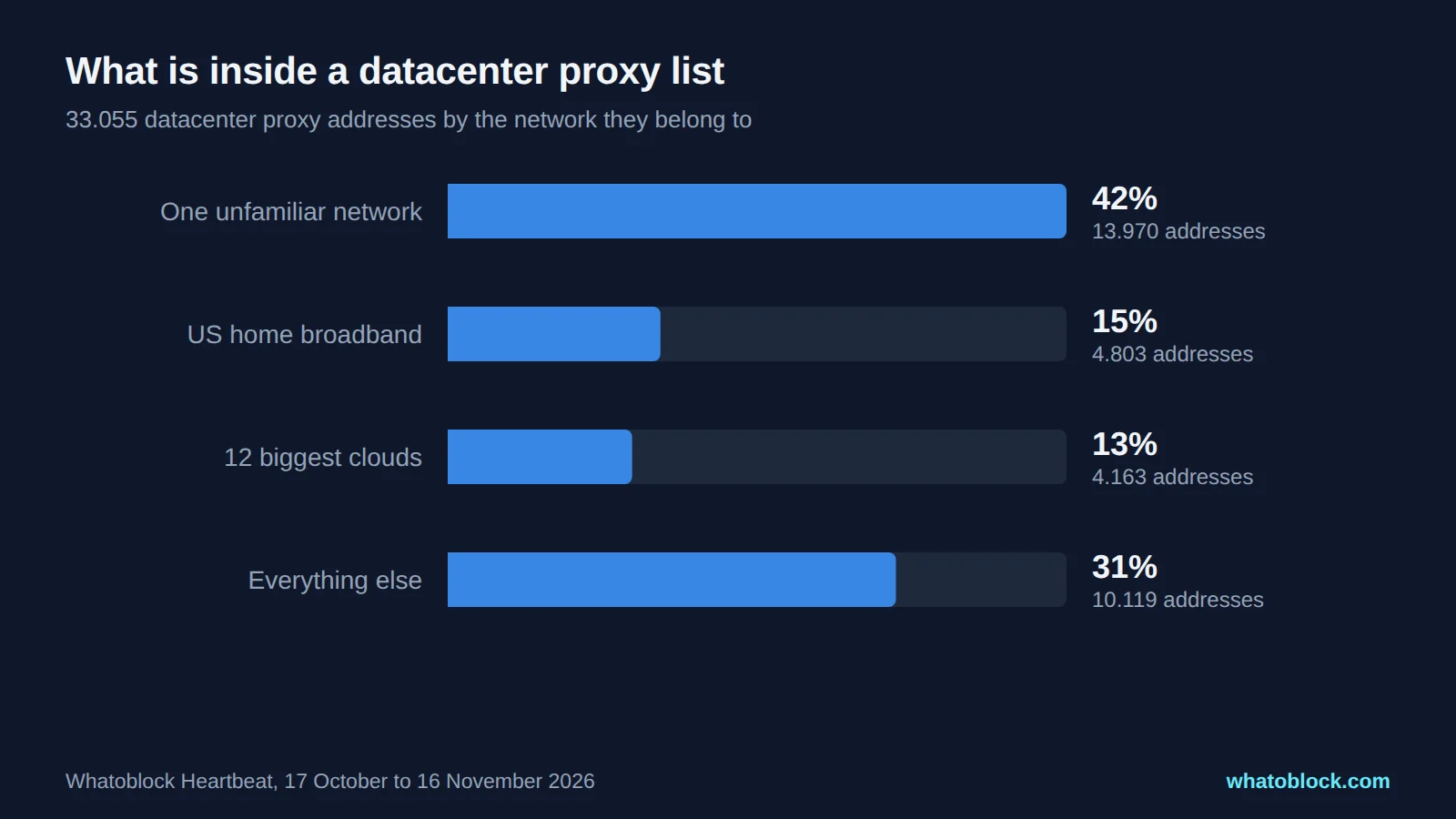
One unfamiliar network is 42% of all datacenter proxy addresses. The 12 biggest clouds are 13%.
What this means if you block proxies
In the residential data, 1.341 addresses were recorded by one collector on 17 October and by a different collector again on 16 November, between 30 and 31 days later. 112 of them (8%) reached our honeypots, against 3% of addresses recorded only once. The difference most likely reflects persistence: these addresses were still working as proxy exits a month later. It is also a small group, 1.341 of 4.545.806 addresses, so treat it as a hint.
- A single record means a device on that network was working as a proxy exit, which is reason enough to treat traffic from the address with more care while it appears in Heartbeat.
- Several addresses in the same network, records from several collectors and attack traffic point to a wider or longer lasting problem.
- Check who holds an address today before acting on its organisation name, which can be years out of date.
- Score residential proxies on public websites instead of blocking them, because the same address may also carry real users. Apply stricter controls to sensitive management interfaces such as SSH, RDP and admin panels, and avoid blanket blocks on residential proxies where legitimate customers or staff working from home may be affected.
- Check whether addresses on your own network appear in Heartbeat. If one of yours shows up as a proxy, find the device behind it, such as a bandwidth sharing app or an infected router.
Explore our daily rankings of residential proxies and datacenter proxies. For background on datacenter proxies, see what is a datacenter proxy.
The bigger picture
A proxy record tells you how an address was used at some point. It does not tell you who owns the network or what they intended. Government offices, satellite terminals, corporate networks and ordinary homes all turn up in proxy data, usually because one device on a shared connection runs software its owner may not know about. IP reputation and malicious intent are different things: weigh how many collectors recorded an address and how many addresses its network has, and keep hard blocks for addresses that also behave badly.
About this data
- Period: 17 October to 16 November 2026, UTC.
- Proxy addresses: tracked by Whatoblock Heartbeat in the residential and datacenter proxy categories. A record is one confirmed proxy exit at the time shown (see Collectors below for how we confirm it). Address totals count each unique IP address once per category.
- Networks: one network is one autonomous system (ASN). Government networks are ASNs registered to a government or public body, 46 in the residential data, picked by their registered name and reviewed one by one. Internet providers owned by towns were left out because they serve ordinary households. Country counts are where IP databases place the addresses, which is not always where a network is registered.
- Repeat records: an address is recorded at most once in 30 days, whichever collector detects it. A detection inside that window is not recorded. A detection after it is recorded again, and it can come from a different collector, which is the only way an address gains a second collector in a 31-day period. No address in this data was recorded twice less than 30 days apart: the shortest gap between two records of the same address is 30 days and 11 seconds. Almost every address therefore appears exactly once, and the number of collectors behind an address is a minimum. A single record is the normal case and means the address was working as a proxy when it was recorded. Beyond that, findings differ in how many addresses a network has, how many collectors recorded them and whether they sent traffic to our honeypots.
- Collectors: Heartbeat runs several separate collectors. Each one connects through the addresses it finds and confirms that traffic leaves from them. The collector count is the number of collectors behind the records of an address, or behind the addresses of a network. Two collectors behind an address means two separate detections, at least 30 days apart. Coverage varies by day and by category, so we report totals and do not compare days.
- Honeypot traffic: anything an address sent to our honeypot sensors in the same period. None of the addresses named in this article was a known research scanner.
- Organisation and country: from IP databases. We flag labels that look wrong. A label means the address is registered to that organisation, not that the organisation runs a proxy.
- We do not publish the individual addresses of the organisations named.
- Affected organisations were notified on 18 November 2026.
Sources
- Layer3, Residential proxies detected on White House network, 4 November 2026
- FBI, Evading residential proxy networks, public service announcement, 12 March 2026
- Google Threat Intelligence Group, No Place Like Home Network: disrupting the world's largest residential proxy network, 28 January 2026
- Jamestown Foundation, Putin expands Federal Protective Service, Eurasia Daily Monitor, 21 September 2026
- Starlink help centre, What IP address does Starlink provide?
Check the live data
Open Heartbeat with residential and datacenter proxies and the last 24 hours selected.